Straight Razor Point Types Explained: The Complete Guide to Razor Tips

Updated: May 1
If you’re getting into traditional wet shaving, one of the first things you’ll notice is that straight razors come in several different blade shapes. While many beginners focus on blade width or grind, the point (or tip) of the razor plays an equally important role in how the razor performs.
Straight razor points affect precision, safety, and shaving style. Some are designed to minimize the chance of cuts, while others offer extremely sharp angles ideal for detailed beard work.
In this guide, we’ll break down the some of the most common straight razor point types, explain their differences, and help you decide which one is right for your shaving routine.
What Is a Straight Razor Point?
The point refers to the tip of the blade at the end opposite the tang. It’s the corner where the razor’s edge meets the spine.
While it might seem like a small detail, the point can dramatically affect:
Precision
Ease of use
Safety
Beard shaping ability
Some razor points are rounded/muted and forgiving, while others are spiked, sharp and designed for intricate work.
Why Experienced Shavers Use Spike Points
The sharp and spiked tip allows for extremely precise control when shaping facial hair. This makes spike point razors popular among barbers and experienced wet shavers.
You can easily define:
Sideburn lines
Mustache edges
Beard outlines
Sharp cheek lines
Advantages
Extremely precise
Perfect for beard shaping
Excellent for tight corners
Disadvantages
Very easy to nick skin
Requires good technique
Not recommended for beginners
While spike points are powerful tools for precision work, they demand careful handling.
Why beginners Or Experienced Shavers Use A Rounded/Muted Point
The round/muted point is the most beginner-friendly razor tip available.
Instead of ending in a sharp tip, the blade curves gently downward to form a rounded or muted tip. This eliminates the sharp spike found on other razors and makes accidental nicks much less likely. Many shavers prefer a rounded/muted point over a spike point. The choice ultimately depends on personal preference and facial geometry. Individuals with more chiseled faces may find it challenging to use a spike point, while those with rounder faces typically have no issues using one.
Why Beginners Love Round Points
When learning to use a straight razor, your technique is still developing. It’s easy to accidentally rotate the blade too far or approach the skin at the wrong angle. With a spike point, that mistake can easily result in a cut. A round point dramatically reduces that risk.
Advantages
Safest razor point
Ideal for beginners
Very forgiving
Great for everyday shaving
Disadvantages
Less precise for shaping
Not ideal for detailed beard lines
For most beginners entering the world of straight razors, the round point is the best place to start.
When it comes to the point design there are numerous options, most of which are offered when placing a custom order.
French point (Spike Tip)
Irish Point (Muted/Rounded Tip)
(French and Irish Point are identical except in the spike or rounded tip configuration)
Spanish Spike (Spike Point)
Classic Spanish (Rounded/Muted Point)
Barber's Notch (Spike Point or Rounded/Muted)
Slider Point (Spike Point or Rounded/Muted)
Straight End (Spike Point or Rounded/Muted)
Half Round Point
French or Irish Point (Oblique Point)
The French point, sometimes called the oblique point, has a unique design where the blade curves inward toward the tip.
Instead of a straight edge ending in a corner, the tip forms a narrow point created by a sweeping curve. This shape creates a fine tip while still maintaining some curvature.
This point is offered in either a flat or beveled curvature.
Why Shavers Like French Points
French point razors strike a balance between precision and control. They allow detailed work without feeling quite as aggressive as a square/straight end point.
Many traditional shaving enthusiasts consider the French point one of the most beautiful straight razor designs.
Barber’s Notch
The barber’s notch is one of the most recognizable and classic straight razor shapes.
It looks similar to a straight end but includes a small notch cut into the blade near the tip. Historically, this notch helped barbers grip the blade when opening the razor.
Today, the design is mostly aesthetic, but it still serves a functional purpose.
Why Barbers Used This Design
In traditional barber shops, razors were opened and closed frequently throughout the day. The notch made it easier to control the blade when unfolding it.
For collectors and enthusiasts of traditional shaving gear, the barber’s notch remains a favorite mostly due to the classic vintage appearance..
Spanish Point
The Spanish point is one of the most dramatic and distinctive razor tips.
Instead of a straight edge or rounded curve, the blade features a concave cut-out.
Why Spanish Points Stand Out
The unique concave design allows the blade to access very tight areas around the face.
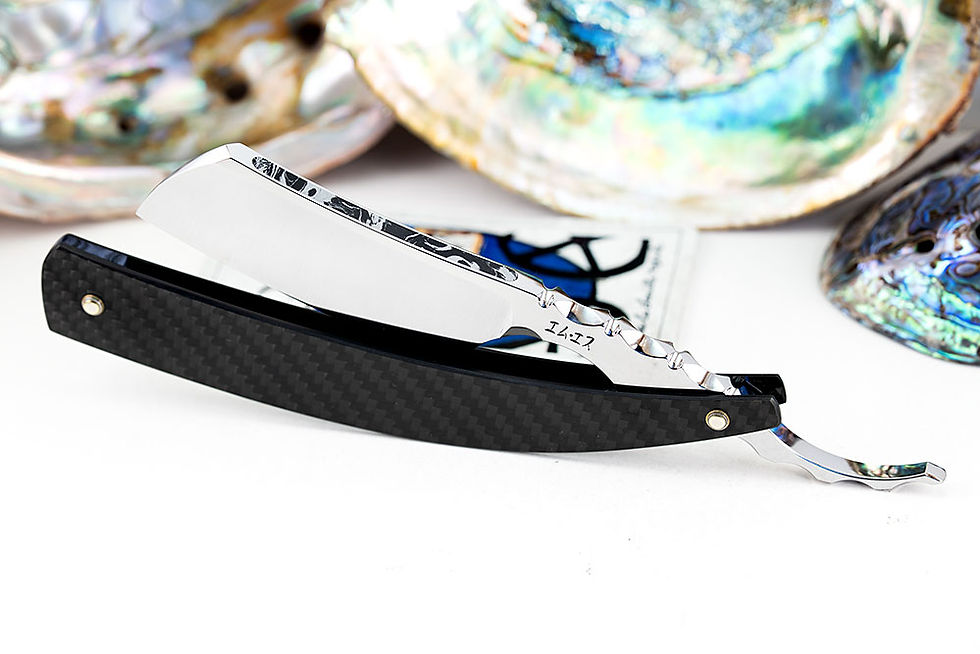
Slider Point
The slider point is a design concept that I developed a considerable amount of time ago and holds a special place in my personal preferences for its aesthetic appeal.
It looks similar to a French/Irish but includes a notch cut into the blade at the top
Final Thoughts
The point of a straight razor may seem like a small detail, but it has a huge impact on how the razor performs.
Whether you choose a forgiving rounded point or a precise spike point, understanding these blade shapes will help you make a better decision when selecting your next razor.
If you're new to straight razors, start simple, focus on technique, and upgrade to more advanced blade tips as your confidence grows.
Mastering these details is part of what makes traditional wet shaving such a rewarding craft.


Comments